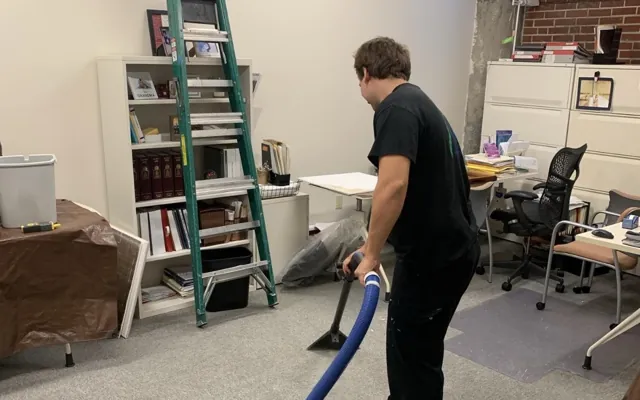
When spring storms flood Downtown's historic blocks and older supply lines fail, the IICRC-standard crews arrive fast to extract water and assess damage. Crews are local, crews know these dense neighborhoods, and crews work to verified-dry standards.

Crews locate the water source in Downtown's maze of old plumbing, shut it off if flowing, and position truck-mounted and submersible pumps matched to the volume and surfaces crews see.
Powerful extractors clear water from carpet, padding, and hard floors down to the subfloor in these older frame and masonry buildings, pulling every gallon crews can reach.
Crews scan crawlspaces, wall cavities, and under cabinets throughout Downtown properties with moisture meters, exposing water hidden in subfloors and framing where it would rot the structure.

Water extraction in Downtown generally runs $500 to $3,000 as a stand-alone service, though it is usually the first phase of a larger drying and restoration job. The cost depends on the volume of water, the category, and how much of it is hidden in the structure. When the loss stems from a sudden, covered event, crews document the source and volume for your insurance claim.
Downtown Little Rock's historic commercial buildings and close-set residential blocks near the Arkansas River rely on systems that are often a century old. A burst pipe or a spring thunderstorm can send water through multiple floors in these dense, low-lying districts before anyone can stop it, and that moisture spreads into walls and crawlspaces where it hides. Downtown sits in a low zone near the Arkansas River where spring thunderstorms with flash flooding are common. Decades-old cast-iron drains and galvanized supply lines corrode and burst. Sump-pump failures and aging systems in crawlspaces leave moisture that spreads fast once a pipe or main-line backs up. From Downtown, crews also cover nearby Quapaw Quarter, Governor's Mansion District, South Main Residential Historic District, MacArthur Park District, Capitol View/Stifft's Station, Hillcrest. See every neighborhood and town on the full service area page.
See all areas servedEvery loss is photographed, measured, and logged from the first visit, so the paperwork holds up with your insurance carrier.
Technicians follow recognized IICRC drying standards and prove the work with daily moisture readings, not guesswork.
Emergency dispatch any hour of the day or night, with a real crew on the way, not a callback in the morning.
A real crew dispatched any hour, not a callback in the morning.
Trained technicians following recognized IICRC drying standards.
Truck-mounted, portable, and submersible for any size loss.
The loss is documented and billed to the carrier directly.
The IICRC-standard teams are based locally in central Arkansas and respond to Downtown, AR calls within 2-4 hours depending on time of day. Crews have equipment staged and ready, so crews can often start extraction the same day the call comes in.
Yes. Historic homes in Downtown benefit most from fast extraction. Crews stop the water source immediately, pump out standing water, and scan behind walls and under floors for hidden moisture in old framing. Early intervention in houses this age makes the difference between a dry restoration and ongoing rot.
Crews are on call 24 hours a day and can be on the way to Downtown within the hour.
Call (501) 287-9058