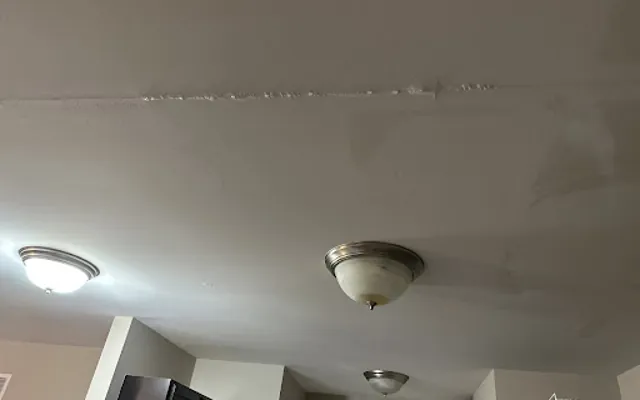
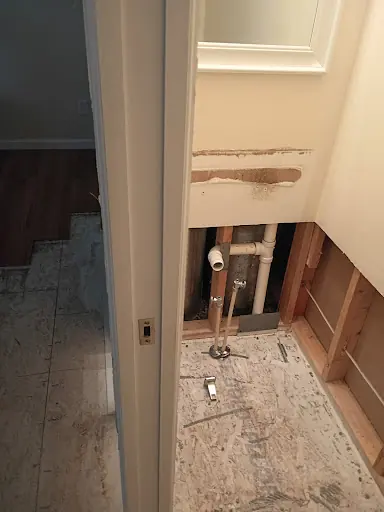
Brown rings, bubbling paint, or a sagging patch overhead all mean water is collecting above your ceiling. Arkansas Water and Fire traces the leak, dries the cavity, and rebuilds the drywall in Little Rock, IICRC-standard, local, and on-site in about an hour.

Crews trace the leak to its origin, whether a roof, a pipe, or an upstairs fixture, using moisture meters and thermal imaging so the repair actually stops the water.
If a ceiling is holding water, crews drain it safely to prevent collapse, then remove saturated drywall and wet insulation so the cavity above can dry out.
Air movers and dehumidifiers dry the joists, remaining drywall, and insulation, with daily moisture checks until the ceiling structure is fully dry, front and back.
Crews hang new drywall, tape and texture it to match, and prime and paint so the finished ceiling shows no sign of the water stain.

While help is on the way, these first steps, done only where it is safe, limit the damage and protect the insurance claim.
Shut the supply off at the source, or close the home's main valve if the source is not obvious. Stopping the flow limits the damage more than anything else.
Switch off electricity to the affected area, but only if the breaker can be reached without standing in or touching the water.
Get a crew dispatched right away. The sooner extraction and drying begin, the more flooring, drywall, and belongings can be saved.
Take photos and a short video of the water and the affected rooms before anything is moved, so the insurance claim starts strong.
Ceiling water damage repair in Little Rock usually runs $600 to $4,000. A small stained patch is inexpensive, while a sagging section that needs drywall replacement, insulation removal, and a texture-matched repaint costs more. If the source is a sudden roof or pipe failure, homeowner insurance often covers the repair. Crews find and document the cause and coordinate the claim with your adjuster.
Crews reach Little Rock and central Arkansas fast, from Hillcrest and The Heights to the Quapaw Quarter, Pulaski Heights, and nearby North Little Rock and Sherwood. See the full list on the areas served across Little Rock page.
See all areas servedEvery loss is photographed, measured, and logged from the first visit, so the paperwork holds up with your insurance carrier.
Technicians follow recognized IICRC drying standards and prove the work with daily moisture readings, not guesswork.
Emergency dispatch any hour of the day or night, with a real crew on the way, not a callback in the morning.
A real crew dispatched any hour, not a callback in the morning.
Trained technicians following recognized IICRC drying standards.
Truck-mounted, portable, and submersible for any size loss.
The loss is documented and billed to the carrier directly.
Yes. A ceiling holding water grows heavy fast and can tear loose and fall without much warning, which is a real hazard to anyone below. Stay out from under a bulging area and call. Crews can drain it safely, take the weight off, and keep the collapse from happening.
Water rarely drops straight down. It runs along the top of the drywall and the joists until it finds a seam or a light fixture to escape through, so the stain can sit several feet from the real source. That is why crews trace the leak rather than just patch the mark.
If the drywall dried quickly and is still solid, a stain-blocking primer and paint can work. But once a panel has sagged, softened, or grown mold on the back, painting only hides a failing surface. Crews check the drywall's condition and replace it only when it truly needs it.
It can, quickly. Wet insulation and the back of the drywall stay damp and warm, and in central Arkansas mold can start within a day or two. Crews dry the cavity fully and treat surfaces when needed, so the problem does not return behind a freshly painted ceiling.
Little Rock crews are on call 24 hours a day, local and fast, and can be on the way within the hour.
Call (501) 287-9058