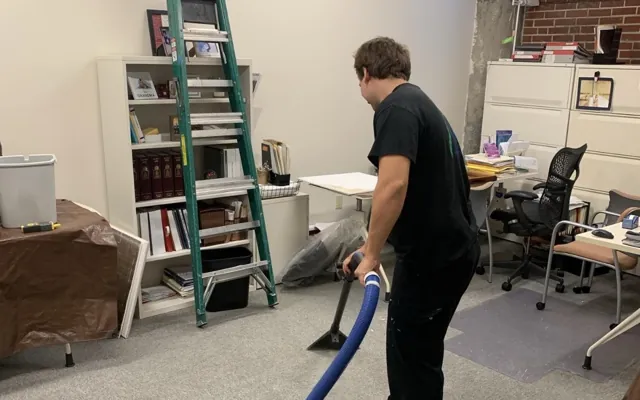
Water pooling on original hardwood in Downtown's dense historic district demands immediate professional extraction and specialized drying by IICRC-standard local crews who truly understand aging cast-iron plumbing systems. Fast response prevents permanent board cupping damage.

Crews pump or mop standing water from floor and surrounding framing, then remove trim to let air reach subfloor and wood underneath. Moisture meters tell the crew how far water spread initially.
Hardwood needs controlled drying, not forced air. Crews use systems pulling moisture from boards and subfloor together, paired with dehumidifiers set to maintain right humidity so wood dries evenly.
Crews check moisture levels in wood each day as drying progresses, noting where cupped boards flatten. Once dry, crews sand and refinish recovered boards, replacing only sections too far gone.

Hardwood floor water damage in Downtown usually runs $1,500 to $7,000, depending on the square footage affected, how long the water sat, and how much can be dried and refinished versus replaced. Fast, specialized drying often saves boards that would otherwise be lost, which lowers the total. When the source is a sudden, covered leak, crews document the damage and coordinate your insurance claim.
Downtown Little Rock's historic core sits low and close-packed, with aging supply lines running through original hardwood floors in every direction. A burst fitting or a spring thunderstorm routing water through multiple floors can soak wood faster than homeowners notice quickly. Keeping irreplaceable floors means drying them fast before moisture sets permanent wave patterns into grain. Downtown's decades-old cast-iron drains and low-lying location near the Arkansas River make homes prone to sudden pipe bursts and flash flooding. Spring thunderstorms overwhelm sewer lines, and burst pipes spread water before anyone spots soft spots. From Downtown, crews also cover nearby Quapaw Quarter, Governor's Mansion District, South Main Residential Historic District, MacArthur Park District, Capitol View/Stifft's Station, Hillcrest. See every neighborhood and town on the full service area page.
See all areas servedEvery loss is photographed, measured, and logged from the first visit, so the paperwork holds up with your insurance carrier.
Technicians follow recognized IICRC drying standards and prove the work with daily moisture readings, not guesswork.
Emergency dispatch any hour of the day or night, with a real crew on the way, not a callback in the morning.
A real crew dispatched any hour, not a callback in the morning.
Trained technicians following recognized IICRC drying standards.
Truck-mounted, portable, and submersible for any size loss.
The loss is documented and billed to the carrier directly.
Most drying happens in first week once systems are running, but hardwood needs time to stabilize properly. Cupped boards in Downtown homes typically recover over two to three weeks if water did not sit too long initially. Crews check moisture daily and only refinish once wood reaches safe level and stays stable for weeks.
Not necessarily always. If water is dried fast enough, most original hardwood in Downtown can recover completely and well. Boards that cupped flatten out as moisture leaves gradually. Crews refinish those boards to match perfectly. Only sections with real damage to wood grain itself, or subfloor too soft to support floor, need replacement completely. Fast drying saves most boards.
Crews are on call 24 hours a day and can be on the way to Downtown within the hour.
Call (501) 287-9058