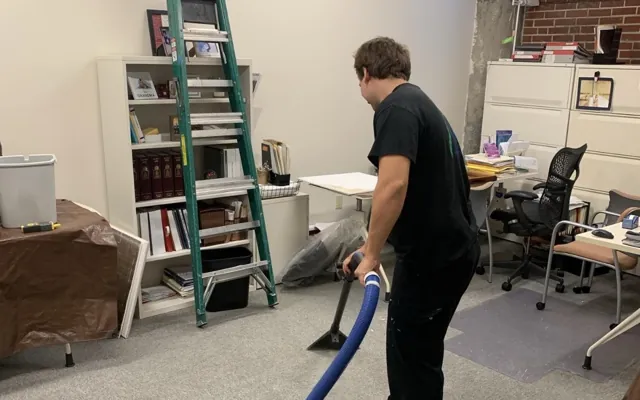
A sewer backup or supply-line failure in MacArthur Park District can spread water through these historic Victorian interiors in hours. IICRC crews respond fast to extract and protect these irreplaceable homes.

Crews identify the burst pipe, sewer backup, or water-heater rupture in MacArthur Park District homes, stop the flow, and measure the volume and category of water present.
Using portable extractors that won't damage original hardwood or plaster, crews pull standing water from rooms throughout these historic homes, protecting each surface as crews work.
Dehumidifiers and air movers target every room in MacArthur Park District homes, including closets and wall cavities, until all moisture is removed and the structure is verified dry.

Water extraction in MacArthur Park District generally runs $500 to $3,000 as a stand-alone service, though it is usually the first phase of a larger drying and restoration job. The cost depends on the volume of water, the category, and how much of it is hidden in the structure. When the loss stems from a sudden, covered event, crews document the source and volume for your insurance claim.
MacArthur Park District holds some of the oldest surviving residential architecture in Little Rock, a walkable pocket of Victorian and early-1900s homes east of downtown. Original plumbing and dated water heaters are the norm here, and a failed fitting or sewer backup can overwhelm these beautiful homes quickly, spreading damage through hardwood floors, plaster walls, and original millwork. MacArthur Park District's original plumbing was installed 80 to 120 years ago and is vulnerable to failure. Cast-iron drains corrode and sewer lines back up. Water heater ruptures and burst supply-line fittings can send water through multiple rooms in these historic homes before the source is found, and the original wood and plaster absorb water quickly. From MacArthur Park District, crews also cover nearby South Main Residential Historic District, Capitol View/Stifft's Station, Governor's Mansion District, Hillcrest, Quapaw Quarter, East Little Rock. See every neighborhood and town on the full service area page.
See all areas servedEvery loss is photographed, measured, and logged from the first visit, so the paperwork holds up with your insurance carrier.
Technicians follow recognized IICRC drying standards and prove the work with daily moisture readings, not guesswork.
Emergency dispatch any hour of the day or night, with a real crew on the way, not a callback in the morning.
A real crew dispatched any hour, not a callback in the morning.
Trained technicians following recognized IICRC drying standards.
Truck-mounted, portable, and submersible for any size loss.
The loss is documented and billed to the carrier directly.
Yes. Crews use gentle extraction and controlled drying techniques specific to older homes. The goal is to remove the water and dry the structure while protecting irreplaceable finishes and architectural details.
Typically 10 to 14 days of continuous drying with daily monitoring. MacArthur Park District homes have lots of plaster and original wood that holds moisture, so thorough drying takes time. Crews monitor progress daily and adjust equipment as conditions improve.
Crews are on call 24 hours a day and can be on the way to MacArthur Park District within the hour.
Call (501) 287-9058