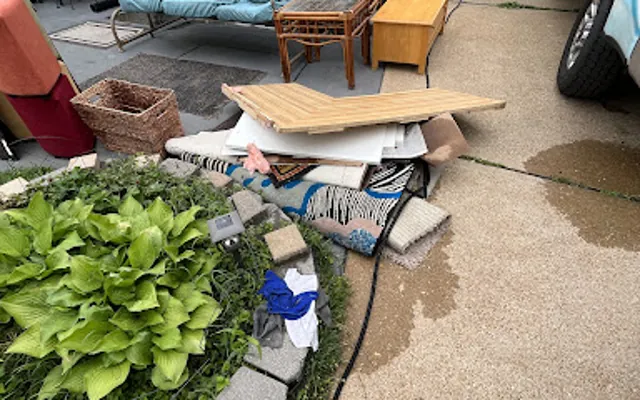
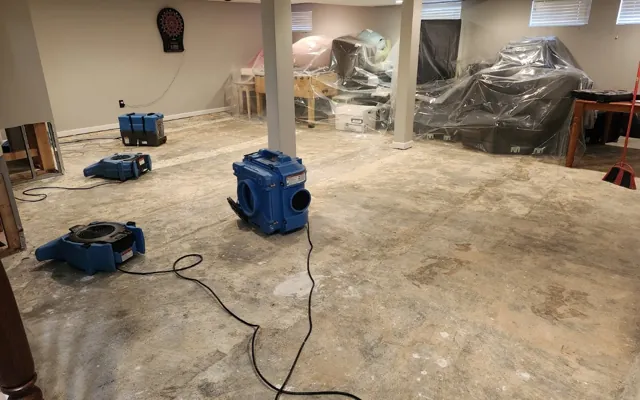
Water flows through MacArthur Park's Victorian homes in minutes after a main break, reaching both upper and lower levels. The IICRC crew traces the path and dries all affected zones with industrial equipment.

Crews locate the main water shutoff and stop flow immediately. Crews then extract standing water from the basement, first floor, and any crawlspace, moving water out before it climbs into upper floors and walls.
Moisture meters reveal where water traveled vertically through walls and how far it penetrated horizontally into subfloors, rim joists, and foundation areas. MacArthur Park's older plaster and wood construction can hide deep moisture, so crews scan upper and lower zones systematically.
Crews position air movers and dehumidifiers on each floor and in the crawlspace to dry the structure methodically. Daily readings track progress throughout the house until all zones reach equilibrium, then crews document completion for your insurance adjuster.

Water main break cleanup in MacArthur Park District generally runs $1,500 to $8,000 for the interior water damage, separate from the line repair. The cost depends on how much water entered, how far it spread, and whether the crawlspace and finished rooms were involved. Coverage varies, since damage from a private service line differs from a city main, so crews document the source and damage carefully for your claim.
MacArthur Park District holds some of the oldest surviving residential architecture in Little Rock, a walkable pocket of Victorian and early-1900s homes east of downtown. Original plumbing and dated water heaters are the norm, and a failed fitting or a sewer backup can spread through these historic interiors before the damage is caught. MacArthur Park homes carry original plumbing and water heater systems more than 80 years old, and any freeze cycle or supply-line corrosion risks a burst. The multi-story structures mean water spreads vertically as well as horizontally, reaching attics, closets, and crawlspaces in a matter of minutes. From MacArthur Park District, crews also cover nearby South Main Residential Historic District, Capitol View/Stifft's Station, Governor's Mansion District, Hillcrest, Quapaw Quarter, East Little Rock. See every neighborhood and town on the full service area page.
See all areas servedEvery loss is photographed, measured, and logged from the first visit, so the paperwork holds up with your insurance carrier.
Technicians follow recognized IICRC drying standards and prove the work with daily moisture readings, not guesswork.
Emergency dispatch any hour of the day or night, with a real crew on the way, not a callback in the morning.
A real crew dispatched any hour, not a callback in the morning.
Trained technicians following recognized IICRC drying standards.
Truck-mounted, portable, and submersible for any size loss.
The loss is documented and billed to the carrier directly.
Yes. Water from a broken main in the basement can travel up the interior walls via wood framing, plumbing cavities, and electrical conduits, reaching the second floor, attic, and closets. Victorian homes in MacArthur Park are especially vulnerable because their older construction has more gaps and voids. That's why crews scan all floors with moisture meters and dry every level with industrial equipment. Early extraction and comprehensive drying prevent mold and structural damage.
Drying time depends on how much water entered and how many floors were affected. A main break affecting just the basement might dry in one to two weeks. If water climbed to the second floor or attic, drying can take three to four weeks because plaster and old wood framing hold moisture for a long time. Crews use industrial equipment and daily monitoring to speed progress, and crews always verify with meters before crews finish.
Crews are on call 24 hours a day and can be on the way to MacArthur Park District within the hour.
Call (501) 287-9058