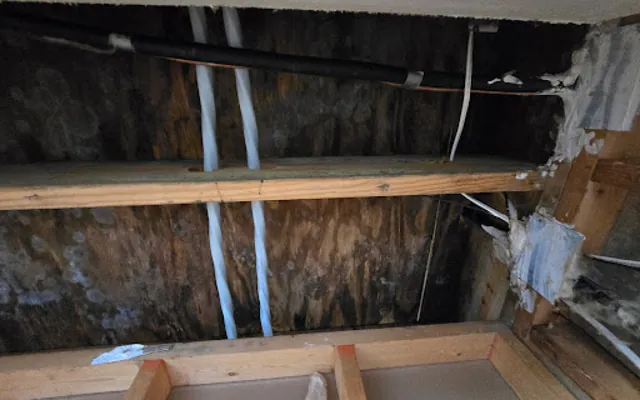
Victorian homes in the Quapaw Quarter sit over full basements where sump pumps fail during spring storms and burst pipes flood lower rooms fast. The IICRC crew arrives same-day to extract and dry the structure before mold sets in.

Crews measure water depth, map its extent through the basement and up interior walls, and remove standing water with pumps. Moisture meters check all exposed wood and concrete, identifying hidden saturation in framing and cavities.
Wet drywall and insulation are removed down to framing. Basement windows are opened, and air movers are positioned to push moisture out through open cavities and up stairwells, breaking the humid cycle.
Dehumidifiers run continuously in basements and on all upper floors where water traveled. Daily readings track moisture levels in rim board, concrete footings, joist ends, and block walls until all zones confirm dry status.

Ice dam water damage in Quapaw Quarter usually runs $1,500 to $7,000 when it happens, since the water often reaches attic insulation, ceilings, and exterior walls at once. The cost depends on how long the dam held and how far the meltwater spread. Sudden ice-dam leaks are commonly covered by homeowner insurance, and crews document the cause and moisture readings for your claim.
The Quapaw Quarter's century-old Victorians come with full basements, a rarity in Little Rock. Heavy spring downpours overwhelm aging sump pumps, and original galvanized supply lines on upper floors burst during hard freezes, sending water down interior walls into the lowest level where it spreads across concrete. Quapaw Quarter's basements and original plumbing make this loss unique here. Sump-pump failures during spring floods push water directly into living spaces. Burst pipes on upper floors send water down framing into basements, where moisture can hide for weeks inside joist cavities and behind block walls. From Quapaw Quarter, crews also cover nearby Governor's Mansion District, South Main Residential Historic District, Downtown, MacArthur Park District, Capitol View/Stifft's Station, Hillcrest. See every neighborhood and town on the full service area page.
See all areas servedEvery loss is photographed, measured, and logged from the first visit, so the paperwork holds up with your insurance carrier.
Technicians follow recognized IICRC drying standards and prove the work with daily moisture readings, not guesswork.
Emergency dispatch any hour of the day or night, with a real crew on the way, not a callback in the morning.
A real crew dispatched any hour, not a callback in the morning.
Trained technicians following recognized IICRC drying standards.
Truck-mounted, portable, and submersible for any size loss.
The loss is documented and billed to the carrier directly.
Moisture absorbed into block walls, concrete, and wood joists creates an ideal environment for mold and wood rot. Within 48 hours, microbial growth begins in hidden cavities. The extraction and drying must start immediately to prevent permanent structural damage.
Sump pump redundancy (a backup battery or second pump) and supply-line upgrade to PEX greatly reduce risk. Crews recommend both for any Quapaw Quarter home with a basement and old galvanized lines.
Crews are on call 24 hours a day and can be on the way to Quapaw Quarter within the hour.
Call (501) 287-9058