HVAC and appliance leaks in riverside Riverdale spread fast across slabs. Crews find the source, extract water immediately, dry the slab, treat for mold, repair, and document so you get your claim paid.

Moisture readers and thermal imaging help the crew trace whether water is coming from an indoor condensate line, an appliance line, a burst pipe under the slab, or seeping in from outside. This identification is critical for your repair and insurance claim.
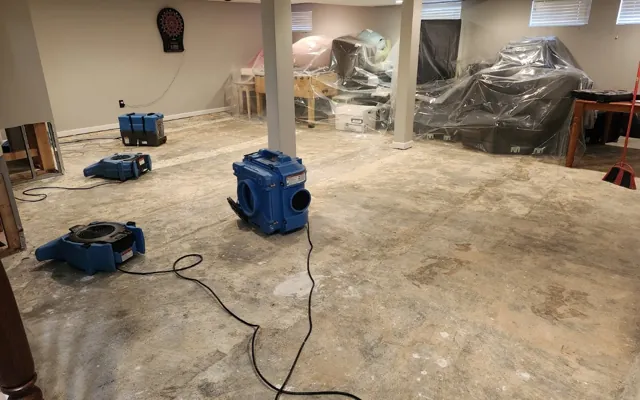
Crews pump or vacuum all surface water, then assess whether crews need injection drying ports under the slab or surface drying only. Industrial dehumidifiers and air movers run until the concrete and any affected wall bases reach dry standard.
Any mold starting in the wall cavity or slab edge gets treated. Crews repair the condensate line, appliance connection, or burst pipe. Crews recommend grading and perimeter drainage to prevent rainwater from pooling around the foundation.

HVAC condensation cleanup in Riverdale usually runs $500 to $3,500. The cost depends on where the unit sits, how long the drain overflowed, and whether the ceiling, platform, or attic framing was damaged. Because these leaks build slowly, insurers sometimes treat them as maintenance, though a sudden pan or line failure may be covered. Crews document the source and moisture readings for your claim.
Riverdale sits on low, flat ground along the Arkansas River west of downtown, mixing older homes and newer condos and offices on slab foundations. Its riverside setting means the water table sits high and storm runoff pools quickly around the building perimeter. An appliance leak, a burst line, or a condensate overflow spreads fast across a slab before homeowners realize. Riverdale's riverside location means a high water table and rapid spring flooding. Slabs here sit close to the grade. Appliance supply lines fail frequently in mid-century and newer homes. Condensate systems overflow in the humid season. Storm runoff accumulates around foundations. From Riverdale, crews also cover nearby Pulaski Heights, East Little Rock, North Little Rock, Hillcrest, The Heights, Capitol View/Stifft's Station. See every neighborhood and town on the full service area page.
See all areas servedEvery loss is photographed, measured, and logged from the first visit, so the paperwork holds up with your insurance carrier.
Technicians follow recognized IICRC drying standards and prove the work with daily moisture readings, not guesswork.
Emergency dispatch any hour of the day or night, with a real crew on the way, not a callback in the morning.
A real crew dispatched any hour, not a callback in the morning.
Trained technicians following recognized IICRC drying standards.
Truck-mounted, portable, and submersible for any size loss.
The loss is documented and billed to the carrier directly.
Slabs sit close to the grade and the high water table here. A condensate line that clogs, an HVAC pan that overflows, or an appliance leak can dump water directly onto the slab surface where it spreads and wicks into walls. Most slabs don't have subsurface drainage.
Call or another restoration company immediately. The longer water sits on a slab, the deeper it penetrates walls and the higher the mold risk. Speed matters. Bring your homeowner's policy details to the first visit; sudden water events from mechanical failures are often covered.
Crews are on call 24 hours a day and can be on the way to Riverdale within the hour.
Call (501) 287-9058