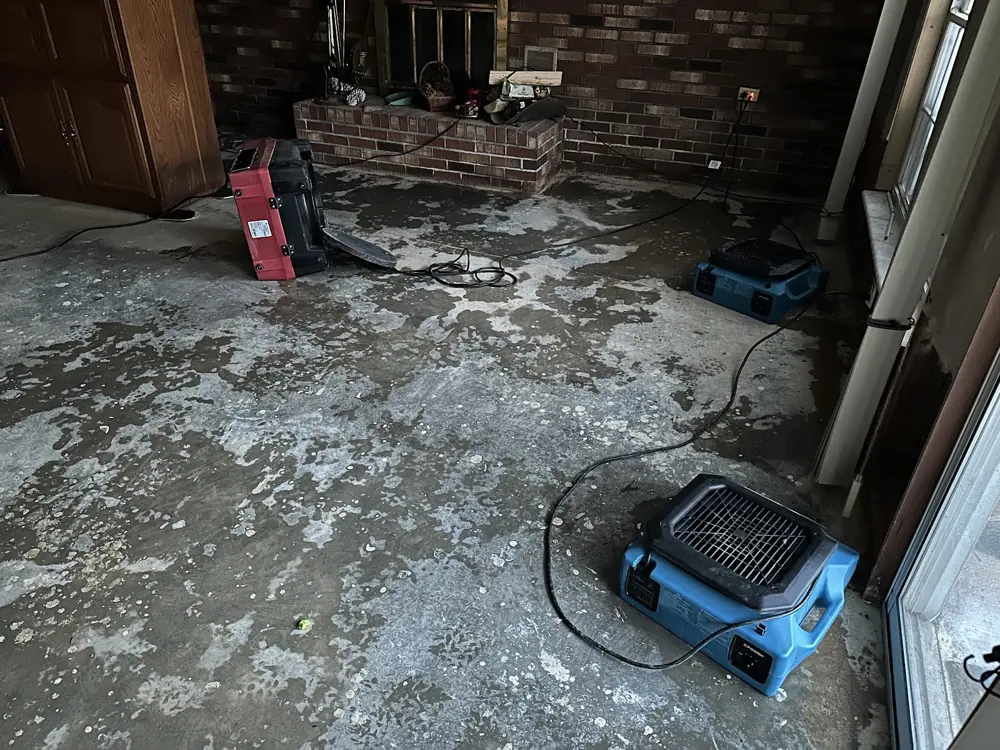
Hard winter freezes and hard spring storms both threaten Alexander homes. A burst pipe or heavy flood can spread through older and newer houses equally fast. The IICRC-standard crew responds immediately to extract water and dry your Alexander home.

Crews identify whether the water came from a freeze rupture, sewer backup, storm seepage, or water heater failure, then remove standing water and document the cause with photographs.
Multiple dehumidifiers and air movers are positioned on all affected floors and in crawlspaces. Crews monitor moisture daily and continue drying until all areas reach ANSI-safe levels.
All wet materials are treated with antimicrobial. Crews recommend freeze protection for pipes, supply-line inspection, water-heater testing, sump-pump installation if needed, and yard grading improvements for Alexander properties.

Garage water damage cleanup in Alexander generally runs $800 to $4,000. The cost depends on how much water entered, whether it crossed into the living space, and how much drywall and stored material was ruined. Sudden causes like a water-heater rupture are often covered by homeowner insurance, while recurring storm runoff may be treated as a maintenance issue. Crews document the cause for your claim.
Alexander is an incorporated town on the Pulaski and Saline county line southwest of Little Rock, mixing older homes with newer subdivisions. Slab and crawlspace foundations are common, and a slow supply-line leak, a water heater rupture, or heavy spring flooding can spread through a house before the source is traced. Alexander homeowners face two distinct seasonal water damage risks: winter freeze ruptures and spring flood events. Alexander's mix of older and newer construction means varying plumbing systems and building standards. Hard winter freezes regularly burst unprotected pipes in attics, crawlspaces, and exterior areas. Spring flooding affects homes on lower elevations. Slab-on-grade and crawlspace foundations present different water damage mechanisms that require careful assessment. From Alexander, crews also cover nearby Shannon Hills, Woodson, Maumelle, East End, Jacksonville, Wrightsville. See every neighborhood and town on the full service area page.
See all areas servedEvery loss is photographed, measured, and logged from the first visit, so the paperwork holds up with your insurance carrier.
Technicians follow recognized IICRC drying standards and prove the work with daily moisture readings, not guesswork.
Emergency dispatch any hour of the day or night, with a real crew on the way, not a callback in the morning.
A real crew dispatched any hour, not a callback in the morning.
Trained technicians following recognized IICRC drying standards.
Truck-mounted, portable, and submersible for any size loss.
The loss is documented and billed to the carrier directly.
Insulation is the most effective method. Crews recommend having a plumber wrap all exposed attic and crawlspace supply lines with foam insulation before winter. Heat-trace cables are an option for difficult-to-insulate areas.
Freeze ruptures produce clean water from the supply line; spring floods produce contaminated water from storm runoff or seepage. Both require professional extraction and drying, but the contamination level affects treatment and cleanup approaches.
Crews are on call 24 hours a day and can be on the way to Alexander within the hour.
Call (501) 287-9058