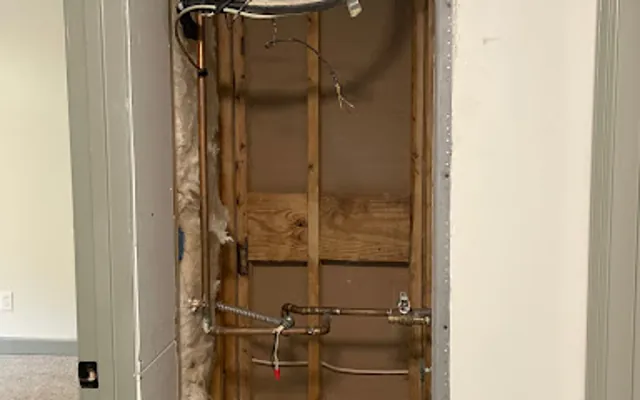
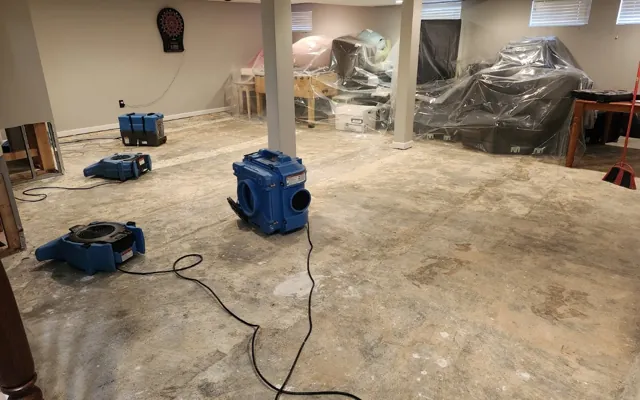
When aging cast-iron drains rupture in Downtown Little Rock's dense historic core near the Arkansas River, fast extraction prevents water spread across multiple floors. The IICRC-standard crew responds within two hours to stop damage and restore.

Crews locate the water source immediately, confirm shutoff at the main, and begin extracting standing water from floors and cavities to prevent spread into adjacent rooms and ceiling spaces.
Wet drywall and trim are opened where necessary. Crews deploy thermal cameras and moisture meters to scan all walls, floors, and ceilings for hidden moisture pockets.
Air movers and dehumidifiers run continuously, with daily moisture readings tracking progress until framing, insulation, and all materials reach safe documented levels.

Burst pipe cleanup in Downtown typically runs $2,000 to $9,000, driven by how long the line ran, how many rooms and floors the water reached, and whether ceilings or hardwood were involved. Sudden pipe breaks are among the most commonly covered water losses on homeowner policies. Crews document the source and damage in detail and bill your adjuster directly.
Downtown Little Rock's low-lying district holds some of the city's oldest commercial and residential buildings, where multi-story structures with aging cast-iron drainage and galvanized supply lines face unique challenges. A pipe burst or backed-up main line spreads fast across connected floors through tightly packed blocks. Downtown's dense, low-lying setting near the river and multi-story layouts make water spread rapidly. Hard freezes, spring thunderstorms with flash flooding, and decades-old piping failures are all common triggers in this aging historic core. From Downtown, crews also cover nearby Quapaw Quarter, Governor's Mansion District, South Main Residential Historic District, MacArthur Park District, Capitol View/Stifft's Station, Hillcrest. See every neighborhood and town on the full service area page.
See all areas servedEvery loss is photographed, measured, and logged from the first visit, so the paperwork holds up with your insurance carrier.
Technicians follow recognized IICRC drying standards and prove the work with daily moisture readings, not guesswork.
Emergency dispatch any hour of the day or night, with a real crew on the way, not a callback in the morning.
A real crew dispatched any hour, not a callback in the morning.
Trained technicians following recognized IICRC drying standards.
Truck-mounted, portable, and submersible for any size loss.
The loss is documented and billed to the carrier directly.
Crews dispatch IICRC crews within two hours of your call during business hours. Downtown's central location means the team is minutes away, which is critical to limiting water spread through multi-story buildings where damage accelerates.
Yes. Crews document the source, damage path, and drying process in detail, then submit the invoice directly to your adjuster. Most burst-pipe losses are covered by policies, and crews handle the paperwork.
Crews are on call 24 hours a day and can be on the way to Downtown within the hour.
Call (501) 287-9058